Wildlife Removal FAQ — Jefferson City, MO
Straight answers to the questions Jefferson City homeowners ask most about raccoons, squirrels, bats, and snakes finding their way into a house. If you are dealing with something right now, skip ahead and contact us — most of these situations only get more involved the longer they sit.
What's making that noise in my attic?
It depends on when you hear it and what it sounds like. Heavy thumping, walking, or dragging sounds at night usually point to raccoons, which are active after dark and large enough to be heard clearly through drywall and insulation. Lighter scurrying and running during the day is a strong sign of squirrels, which keep daytime hours. A faint fluttering, rustling, or high-pitched squeaking around dusk — especially coming from inside a wall or near a roofline — points toward bats stirring before they leave to feed. Scratching low in a wall, in a basement, or near a foundation with no clear pattern can be a snake rather than anything nesting overhead. None of this is a certainty from sound alone, which is why an actual look at the attic and the roofline matters before assuming which animal you have got.
How much does wildlife removal typically cost?
It varies with the species, how the animal got in, and how much damage or cleanup is involved. A straightforward trapping and removal job typically costs less than a full exclusion project that involves sealing multiple entry points across a roofline. Bat exclusion tends to run higher than a single-raccoon removal because it usually involves treating every potential gap on the structure, not just one hole. Attic cleanup after an infestation — pulling contaminated insulation, sanitizing, replacing what cannot be saved — adds cost on top of the removal itself. We give real numbers once we know what we are actually dealing with, not a guess over the phone.
Is wildlife removal humane?
That is the goal, and it shapes how a job gets done. Exclusion — letting an animal leave on its own and then sealing the entry point behind it — is preferred over methods that trap an animal inside a structure or rely on poison, which usually just causes the animal to die somewhere you cannot reach it. When kits or pups are involved, the approach accounts for them too; separating a mother from young that cannot yet leave on their own is not humane and it is not effective, since the young left behind will not survive and the smell that follows is its own problem. Humane and effective tend to point the same direction here.
Why does bat removal depend on the time of year?
Because bats raise flightless young inside the roost for part of the year, and excluding adult bats during that window traps the young inside with no way out. Responsible bat exclusion gets scheduled around that reality rather than around convenience. Some bat species found in Missouri also carry additional protections under state and federal wildlife rules. We are not going to give you legal advice about a specific species or situation, but timing is planned around these seasonal patterns rather than treated as optional.
Will raccoons or squirrels come back after they're removed?
If the entry point is not sealed, yes — often quickly. Animals do not view a den site as a one-time discovery; a gap that worked once tends to get used again, whether by the same animal or a different one that finds the same opening. This is why removal without exclusion tends to be a short-term fix. Full exclusion — locating and sealing every gap an animal could use, not just the one that was obviously in use — is what actually stops the cycle.
Who fixes the damage left behind?
That depends on what got damaged. We handle the wildlife side directly — removing contaminated insulation, cleaning affected surfaces, sealing entry points, and general attic cleanup. Structural repairs beyond that, like replacing a section of roof decking or rebuilding a soffit that was torn open, typically fall to a contractor or roofer. We will tell you plainly which category your damage falls into so you are not stuck guessing who to call next.
Are raccoon or bat droppings actually dangerous?
They can be, which is why we do not recommend cleaning up a heavy accumulation yourself. Raccoon droppings can carry a roundworm that poses a real risk if disturbed and inhaled or ingested, particularly for children and pets. Accumulated bat guano is linked to a fungal lung infection that can develop when dried droppings get disturbed and airborne, especially in an enclosed attic space. A small, fresh amount is a different situation than months of buildup in an attic corner. When in doubt, keep the area closed off and treat cleanup as a job for someone with the right protective equipment, not a weekend project.
Can't I just set a trap myself?
You can buy a trap, but a few things tend to go wrong. Missouri regulates trapping and relocating wildlife, and hardware-store traps are easy to set in a way that catches the wrong animal, injures it, or leaves it somewhere you now have to deal with directly. Even a successful trapping does nothing about the entry point, so a new animal often shows up within weeks. And if the animal is a mother with young nearby, trapping her alone leaves the young to die in the structure, which creates the exact smell-and-cleanup problem you were trying to avoid. It is not that DIY trapping never works — it is that it solves less of the problem than it looks like it does.
How do raccoons and squirrels get into a house in the first place?
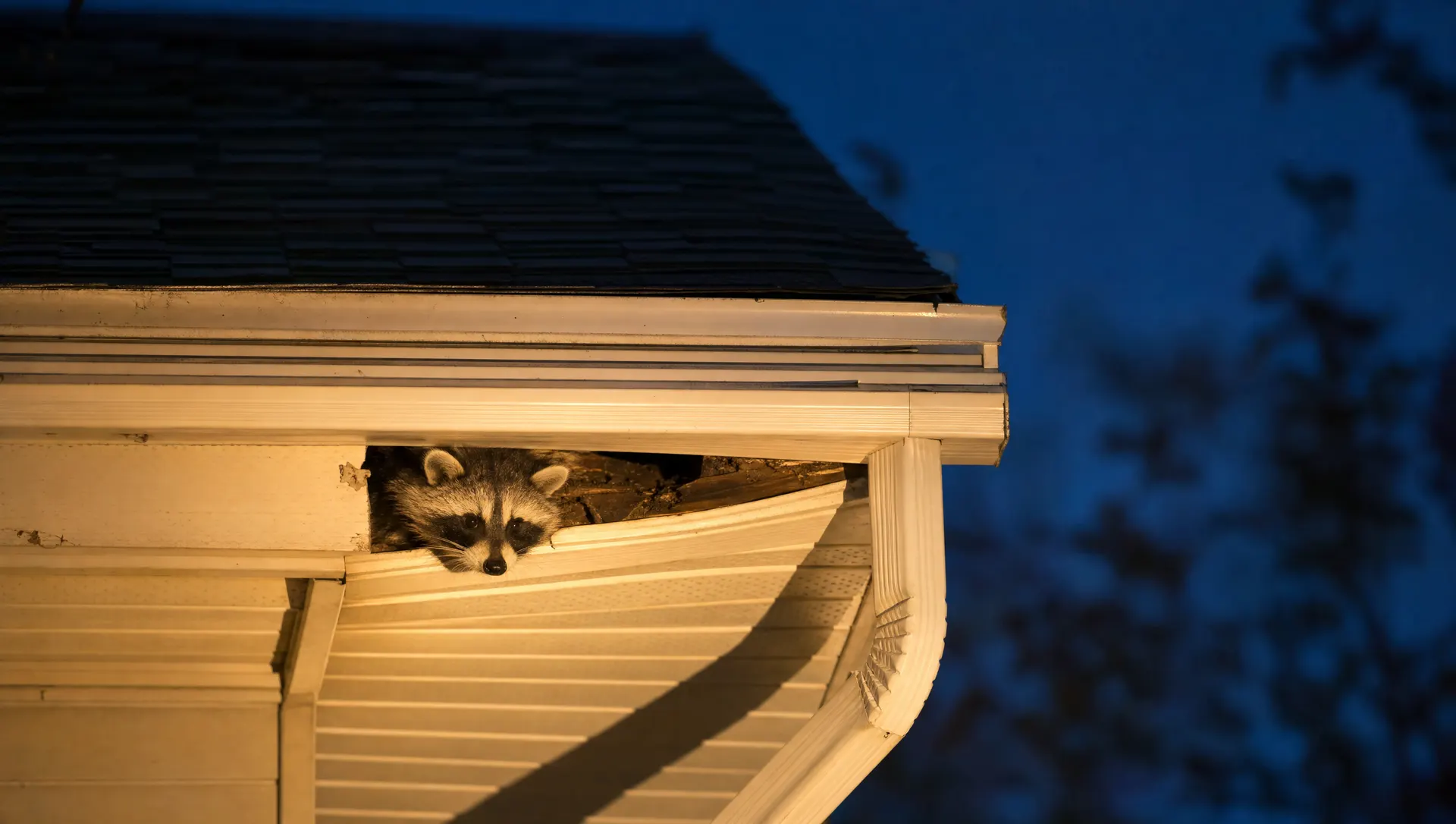
Mostly through gaps that already exist and just need to be found — or enlarged. Raccoons are strong enough to pry up loose flashing, tear into a soffit corner, or push through a weakened gable vent, and they will use an uncapped chimney without hesitation. Squirrels look for smaller gaps at the roofline, gnaw at fascia boards and vent screens that have already started to soften, and can use overhanging tree limbs or power lines as a direct path onto a roof. Older homes with original wood soffits and vents tend to have more of these gaps than newer construction, simply from decades of wood shrinking, warping, and settling at the corners and seams.
Are the snakes around Jefferson City dangerous?
Most of what turns up in a basement, garage, or yard is harmless. Garter snakes, black rat snakes, and similar non-venomous species are common in this area and are actually useful to have around, since they eat mice and other rodents. Missouri does have venomous species, and the copperhead is the one most likely to be encountered near a woodpile, rock wall, or foundation gap in the Jefferson City area. The honest answer is that telling a young rat snake from a copperhead is not always easy at a glance, so a snake you cannot confidently identify is one to keep your distance from and have looked at rather than one to assume is safe or assume is dangerous.
Does homeowners insurance cover wildlife damage?
Usually not for the removal itself, and coverage for resulting damage is inconsistent. Most standard homeowners policies treat wildlife entry as a maintenance issue rather than a covered peril, so trapping and exclusion costs typically come out of pocket. Some policies will cover secondary damage — like fire risk from chewed wiring, or a ceiling that sagged under a wet, urine-soaked insulation load — but plenty of policies exclude that too if the underlying cause is considered gradual or preventable. Check your specific policy before assuming either way; do not wait for a claim denial to find out.
What time of year is wildlife activity worst here?
Fall and spring both bring spikes, for different reasons. In fall, animals look for a warm, dry place to den for winter, and an attic looks a lot like a hollow tree to a raccoon or squirrel. In spring, raccoons, squirrels, and bats are raising young, and a mother looking for a safe den site is highly motivated to get inside. Summer brings its own bat activity as colonies grow and become more active feeding on insects. Winter is quieter but not silent — an established den does not necessarily empty out just because it is cold outside.
What areas do you serve?
Jefferson City and all of Cole County, plus the surrounding communities: Holts Summit, St. Martins, Taos, Wardsville, Russellville, Centertown, and Eugene. If you are searching for wildlife removal anywhere in the capital city area, we can get help to you.
Get Help Now
If something has moved in where it does not belong, tell us what you are seeing or hearing and we will help you figure out what it is and what it takes to handle it, anywhere in the Jefferson City area.
Need Help in Jefferson City Right Now?
Tell us what you need and we'll get back to you fast with a free, no-pressure quote.